
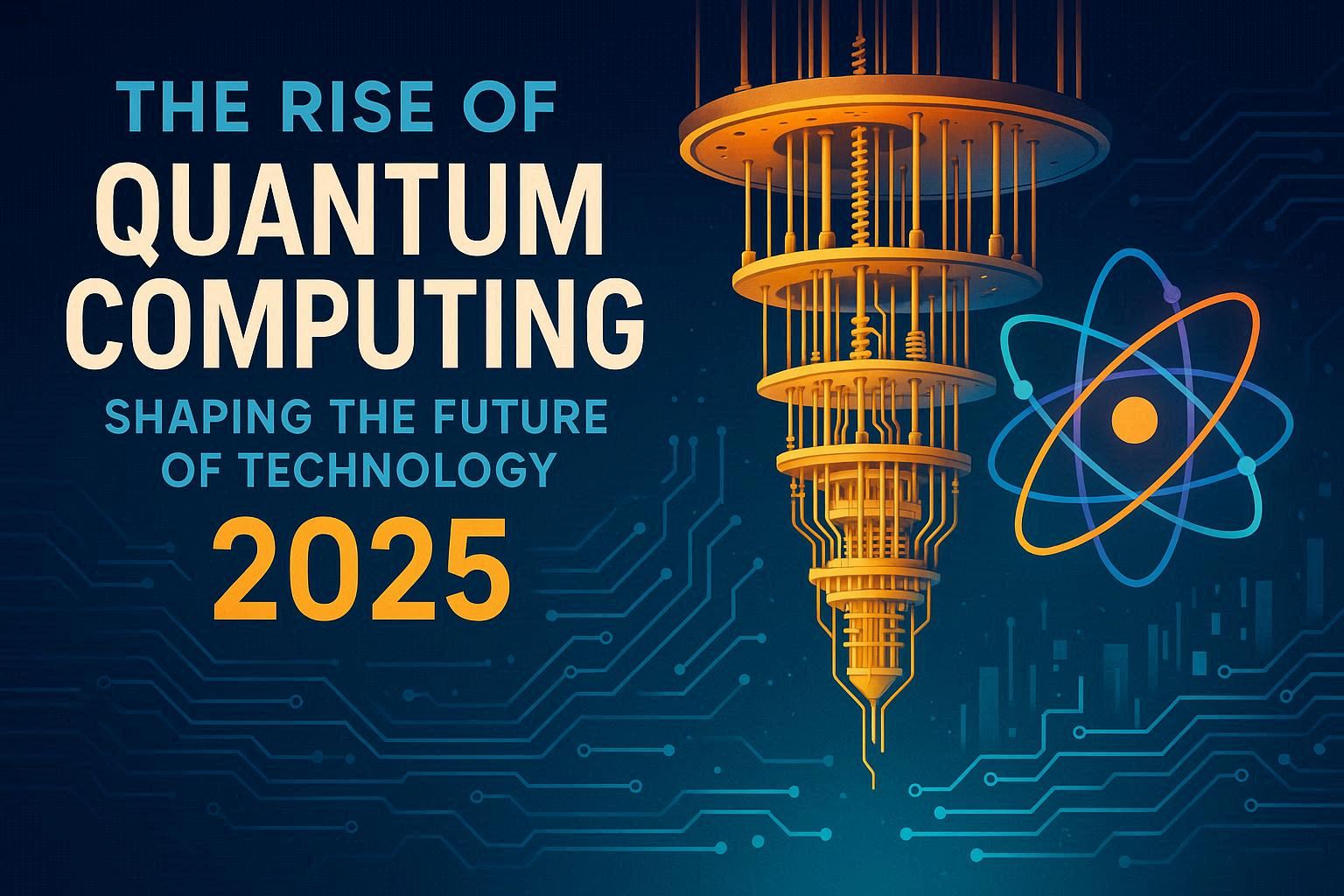
Quantum computing, once a concept of theoretical physics, is now emerging as one of the most powerful technologies of the 21st century. In 2025, global tech leaders and research institutions are racing to unlock its potential. Unlike traditional computers that process information in binary code, quantum computers use quantum bits—or qubits—that can represent multiple states simultaneously. This ability gives them the power to solve complex problems far beyond the reach of classical machines.
1. Understanding Quantum Computing
Quantum computing is based on the principles of quantum mechanics—superposition, entanglement, and interference. Superposition allows qubits to exist in multiple states at once, while entanglement links qubits so that changes in one instantly affect another. Together, these properties enable quantum computers to perform calculations at speeds unimaginable to conventional systems.
2. Why Quantum Computing Matters
Traditional computers struggle with problems that involve vast combinations of possibilities, such as molecular simulations, cryptography, and optimization tasks. Quantum computing, on the other hand, can process these scenarios simultaneously. This makes it a breakthrough technology for industries that rely on data analysis, prediction, and modeling.
3. Quantum Computing and Artificial Intelligence
AI and quantum computing are a powerful combination. Quantum algorithms can train AI models faster, analyze larger datasets, and improve machine learning accuracy. By reducing the time needed for complex computations, quantum computing could accelerate innovation in natural language processing, robotics, and autonomous systems.
4. Transforming Cybersecurity
While quantum computing offers immense benefits, it also poses risks—especially to cybersecurity. Quantum processors could potentially break current encryption methods in minutes, endangering global data security. However, this challenge is also an opportunity. The rise of quantum-safe encryption is driving the next generation of secure communication systems designed to protect information in the quantum era.
5. Applications Across Industries
Quantum computing has applications far beyond tech companies. In healthcare, it can accelerate drug discovery by simulating molecular structures. In finance, it can optimize portfolios and detect fraud in real time. In logistics, it helps design efficient supply chains, and in energy, it models renewable power grids to reduce waste. The potential for innovation is virtually limitless.
6. The Global Quantum Race
Countries like the United States, China, and members of the European Union are investing billions in quantum research. Tech giants such as IBM, Google, and Intel have already built prototype quantum computers, while startups are exploring cloud-based quantum services. The competition to achieve “quantum supremacy”—a point where quantum computers outperform classical ones—is reshaping the global tech landscape.
7. Challenges and Limitations
Despite rapid progress, quantum computing is still in its early stages. Qubits are extremely sensitive and must be maintained at near-absolute-zero temperatures to function properly. Scaling quantum systems remains a major engineering challenge, as does developing practical software for real-world applications. Scientists are working tirelessly to improve qubit stability, error correction, and hardware design.
8. The Future of Quantum Technology
By 2030, quantum computing could become a mainstream tool for solving the world’s most complex problems—from climate modeling to global financial forecasting. As access expands through cloud platforms, small businesses and universities will also benefit from its computational power. The integration of quantum technology into everyday applications will mark the beginning of a new digital revolution.
Conclusion
Quantum computing in 2025 stands at the crossroads of science and innovation. Its potential to transform industries, accelerate AI, and redefine cybersecurity makes it one of the most influential technologies of the decade. While challenges remain, the global momentum behind quantum research ensures that this technology will continue to evolve rapidly. The quantum era is no longer a distant dream—it is here, and it is reshaping the future of technology.