
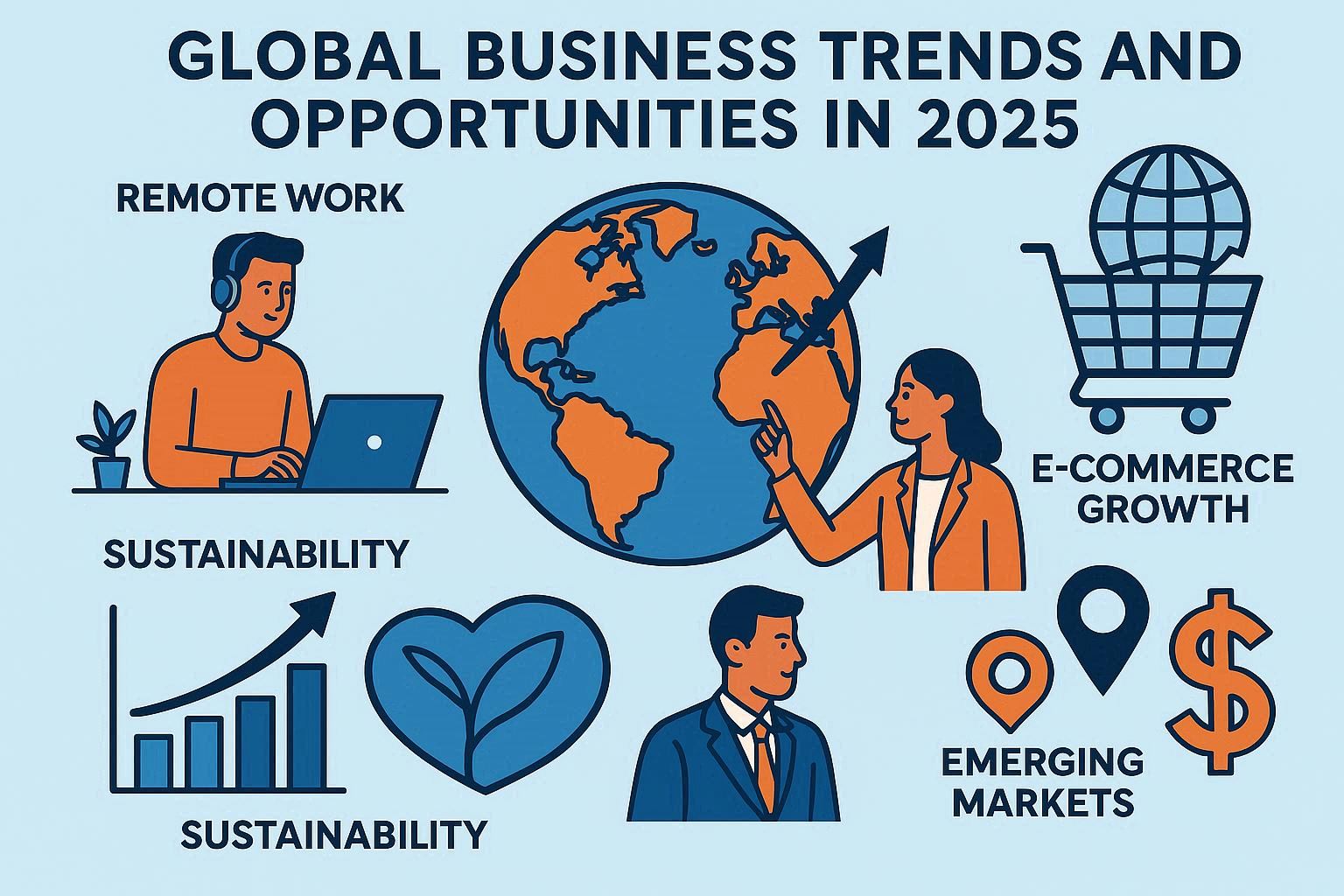
The global business landscape in 2025 is defined by transformation, innovation, and resilience. After years of economic challenges, technological acceleration, and shifting consumer behavior, businesses are rethinking their strategies to stay competitive. Artificial intelligence, automation, sustainability, and global connectivity are no longer future goals — they are the foundation of modern business success.
This article explores the most important business trends and opportunities shaping 2025 and what companies must do to thrive in a fast-changing world.
1. Digital Transformation Accelerates Growth
Digital transformation continues to be the driving force behind business evolution. Companies across all sectors are leveraging cloud computing, data analytics, and AI to streamline operations, improve customer engagement, and enhance decision-making. In 2025, even small and medium-sized enterprises are investing heavily in automation tools and digital marketing to compete globally.
Businesses that adopt digital-first strategies are seeing improved efficiency, lower costs, and faster innovation cycles. The future belongs to those who can integrate technology seamlessly into their operations and customer experiences.
2. Artificial Intelligence and Automation
AI has moved from theory to reality. From predictive analytics to intelligent chatbots, automation is transforming how businesses operate. AI helps companies predict consumer trends, optimize supply chains, and personalize customer interactions. Meanwhile, robotic process automation (RPA) handles repetitive administrative tasks, freeing employees to focus on creativity and strategy.
In 2025, companies that strategically integrate AI are gaining a significant competitive edge, boosting productivity while improving service quality.
3. Sustainability and Green Business Practices
Consumers and investors are increasingly prioritizing sustainability. Businesses are responding by reducing carbon footprints, adopting circular economy models, and implementing eco-friendly production. In 2025, green business isn’t just a moral obligation — it’s a competitive advantage. Companies that demonstrate environmental responsibility attract loyal customers and long-term investment.
Renewable energy adoption, waste reduction initiatives, and transparent ESG (Environmental, Social, and Governance) reporting are now essential for global market credibility.
4. Remote Work and the Hybrid Workforce
The global workforce has evolved permanently. Remote and hybrid models are now standard practice across industries. Businesses are focusing on digital collaboration tools, flexible scheduling, and employee wellbeing to maintain productivity and attract top talent.
In 2025, location-independent work creates new global hiring opportunities, enabling businesses to access skilled workers from any region while reducing operational costs.
5. E-Commerce Expansion and Digital Payments
Online business continues to grow exponentially. Consumers expect seamless digital experiences, fast delivery, and secure payments. Innovations in e-commerce logistics, AI-driven recommendations, and mobile wallet adoption are redefining how people buy and sell globally.
Digital payment systems — including cryptocurrency and central bank digital currencies — are also becoming mainstream, offering faster, safer, and more transparent transactions for businesses and consumers alike.
6. Global Supply Chain Reinvention
After years of disruption, global supply chains are being restructured for resilience. Businesses are diversifying suppliers, localizing production, and using real-time tracking technologies to reduce vulnerability to geopolitical and environmental risks.
Automation, AI forecasting, and blockchain transparency tools are helping companies build smarter, more sustainable supply chains that can adapt quickly to change.
7. The Rise of Small Businesses and Startups
2025 is an excellent year for entrepreneurship. Low entry barriers, digital marketing, and global connectivity have empowered startups to compete with large corporations. Innovative small businesses are thriving in niches like fintech, e-commerce, health tech, and renewable energy.
Governments and investors are increasingly supporting entrepreneurs through incubators, grants, and crowdfunding platforms that drive local and global innovation.
8. Customer Experience as a Growth Driver
Customer experience (CX) has become a decisive factor for business success. Personalized interactions, real-time support, and consistent brand storytelling help build loyalty. In 2025, AI-driven analytics allow companies to anticipate customer needs, enhance satisfaction, and create emotional connections with their audiences.
Businesses focusing on customer-centric strategies are outperforming competitors by turning engagement into long-term relationships.
9. Business Resilience and Risk Management
In an uncertain world, resilience is a core business value. Companies are adopting agile models to respond quickly to crises — from supply chain disruptions to cybersecurity threats. Business continuity planning, risk diversification, and digital security measures are now central to corporate strategy.
Those who plan ahead for disruption not only survive challenges but also emerge stronger and more adaptable.
10. Cross-Border Business and Emerging Markets
Emerging markets in Asia, Africa, and Latin America are driving global growth. With expanding middle-class populations and increased digital penetration, these regions offer enormous opportunities for investment and partnerships. Businesses that localize products and understand regional cultures can tap into millions of new customers.
At the same time, global trade is being reshaped by digital platforms that make it easier than ever for small companies to access international markets.
11. Leadership and Workplace Culture Evolution
Modern leadership in 2025 emphasizes empathy, inclusivity, and innovation. Employees expect transparency, flexibility, and meaningful work. Companies that cultivate supportive cultures see higher retention and stronger performance. Leadership is no longer about control — it’s about empowering teams and fostering creativity in a constantly evolving environment.
12. Data-Driven Decision Making
Big data continues to redefine how businesses make decisions. From marketing analytics to financial forecasting, companies rely on real-time insights to optimize operations. Data democratization — making analytics accessible to all employees — helps organizations move faster and make more informed choices.
Conclusion
Business in 2025 is defined by adaptability, innovation, and digital excellence. Companies that embrace technology, sustainability, and customer-centric thinking are thriving in a competitive global market. The integration of AI, data analytics, and green strategies creates a path toward smarter, more resilient businesses.
As global challenges persist, the greatest opportunities lie in transformation — reimagining how value is created, delivered, and sustained. The future of business belongs to those who innovate boldly, act responsibly, and stay connected to an ever-evolving world.